
.avif)
Houston Child Custody Modification &
Enforcement Attorney
Adapting Custody Orders to New Realities
.avif)
.avif)
.svg) 15+ Years
15+ Years
of Family Law Experience.svg) 2,000+ Cases
2,000+ Cases
on Family Law Resolved A+ Google
and BBB Rating.svg) Extensive Local
Extensive Local
Courts Expertise
Your Trusted Houston Family Attorneys
Longworth Law Firm focuses on helping Houston parents with custody modifications and enforcement issues, using smart strategies based upon decades of experience. Founder Daryl Longworth's unique background includes 28 years as a Houston Police Lieutenant and 15 years practicing family law, providing a valuable perspective when addressing non-compliance with court orders.
Our firm has earned recognition among Houstonia Magazine’s Top Lawyers and maintains an A+ BBB rating for our assertive yet empathetic approach to family matters. We're available 24/7 to address urgent custody concerns and pride ourselves on transparent communication throughout the legal process.

When You Can Modify Child Custody in Houston
In Texas, you can modify a child custody order when there has been a material and substantial change in circumstances since your original order was established. The courts in Houston and Harris County require clear evidence that modification serves your child's best interests.
Harris County Family Courts handle modification cases with specific local procedures that differ from those of surrounding counties. Before filing a modification petition, it's important to understand both the legal grounds and the procedural requirements unique to the Houston court system.
Material and Substantial Change in Circumstances
Texas law requires you to demonstrate that a "material and substantial change" has occurred since your original order was entered. This legal standard is the foundation of any successful modification case.
A material and substantial change is a significant alteration in circumstances that affects your child's well-being or the parents' ability to follow the current order. Courts in Harris County evaluate each situation individually, but certain changes consistently meet this threshold:
- Safety concerns, including family violence, substance abuse, or endangerment
- Parental relocation outside geographic restrictions
- Job changes affecting parenting schedules
- Changes in the child's medical, educational, or developmental needs
- Remarriage or significant household changes
- Military deployment or return from service
The One-Year Rule for Custody Changes
Texas Family Code includes a critical limitation: you generally cannot file to modify conservatorship or primary residence within one year of your original order or most recent modification.
However, exceptions exist when:
- Your child's present environment may significantly impair their physical health or emotional development.
- The primary conservator has voluntarily relinquished care and possession for at least six months.
- The primary conservator agrees to the modification.
These exceptions require filing an affidavit with specific allegations that must be verified under oath. This procedural hurdle prevents frequent, destabilizing changes while allowing modifications when truly necessary for a child's welfare.
Common Grounds for Modification
The most frequently accepted grounds for modification in Harris County courts include:
- Safety concerns: Family violence, substance abuse, or dangerous living conditions.
- Relocation: One parent moving outside geographic restrictions.
- Child's preference: For children 12 or older (though not determinative).
- Parental cooperation issues: Consistent interference with possession or access.
- Changes in the child's needs: Medical conditions, educational requirements, or developmental issues.
- Schedule conflicts: Work schedule changes making the current arrangements unworkable.
- Three contempt findings: Under the new 2025 Texas law (§156.107), three enforcement findings constitute a material change.
Types of Custody Modifications in Texas
Harris County courts consider various types of custody modifications depending on your specific circumstances.
Changing Primary Conservatorship
The most substantial modification involves changing which parent has the right to determine the child's primary residence. These high-stakes cases require compelling evidence of a material change and that the modification serves the child's best interests.
Modifying Possession Schedules
Often, parents need to adjust visitation schedules without changing primary conservatorship. This might involve:
- Adapting to new work schedules
- Accommodating school activities
- Addressing transportation challenges
- Equalizing parenting time
Geographic Restriction Changes
Many Houston custody orders contain geographic restrictions limiting where the child can reside (typically Harris County and contiguous counties). Modifications can either:
- Remove restrictions to allow relocation
- Add restrictions when none existed
- Modify existing boundaries
Child Support Modification
While technically separate from custody issues, support modifications often accompany custody changes. Texas allows support modifications when:
- Three years have passed since the last order AND the monthly amount would change by 20% or $100.
- A material and substantial change affects income or expenses.
The Modification Process in Harris County
Navigating the Harris County Family Courts requires understanding the specific procedural requirements for custody modifications.
Agreed Modifications
When both parents agree to proposed changes, the process becomes streamlined:
- Joint filing of modification petition
- Drafting and signing an agreed order
- Brief court appearance to finalize (sometimes waived)
- Typical completion within 60-90 days
- Lower costs and reduced emotional strain
Despite agreement, the court must still find that the changes serve the child's best interests.
Contested Modifications
When parents disagree about changes, the process becomes more complex:
- Filing and service of the modification petition
- Temporary orders hearing (if requested)
- Discovery process to exchange information
- Mandatory mediation in Harris County
- Settlement negotiations
- Trial if settlement fails
- Timeline of 6-12 months in most cases
Required Documentation
Harris County modifications require specific documentation:
- Petition to Modify the Parent-Child Relationship
- Copy of current order
- Affidavit (if filing within one year)
- Income and expense information
- Evidence supporting claimed changes
- Proposed parenting plan
Enforcing Your Custody Order
When the other parent violates court orders, enforcement actions protect your rights and your relationship with your child.
Common Custody Order Violations
Houston families frequently experience these types of violations:
- Denial of visitation: Refusing to allow court-ordered access to your child.
- Interference with possession: Consistently late exchanges, returning early, and keeping beyond scheduled times.
- Custodial interference: Refusing to return the child, taking without authorization.
- Communication barriers: Blocking phone calls or virtual visitation.
- Withholding information: Failing to share medical or educational information.
- Moving without permission: Violating geographic restrictions.
When to Take Legal Action
While minor or isolated incidents might be resolved through communication, legal enforcement becomes necessary when:
- Violations are repeated or establish a pattern
- The other parent shows willful disregard for the order
- Your relationship with your child is being damaged
- Attempts at resolution through co-parenting communication have failed
Documenting Violations
Successful enforcement requires thorough documentation:
- Detailed visitation logs with dates, times, and descriptions
- Saved communications (texts, emails, recorded calls if legal)
- Witnesses present during incidents
- Photos of attempted exchanges
- Police reports, when applicable
- Calendar entries and timeline records
Common Scenarios Requiring Modification or Enforcement
Certain situations commonly lead to both modification and enforcement proceedings in Harris County.
Parental Relocation (Modification)
When one parent needs to move beyond geographic restrictions due to job changes, family needs, or other circumstances, modification becomes necessary. These cases focus on:
- Whether the move is in the child's best interests.
- How the non-relocating parent will maintain meaningful access.
- Potential adjustments to possession schedules.
- Whether geographic restrictions should be lifted or modified.
Denied Visitation (Enforcement)
When a parent consistently denies court-ordered access, enforcement protects your rights. These cases involve:
- Proving willful violations of specific order provisions.
- Documenting each denial with dates, times, and circumstances.
- Seeking make-up time, contempt findings, and possibly attorney's fees.
- Establishing a record that may support future modification.
Safety Concerns (Both)
When concerns about a child's safety arise, both modification and enforcement may be necessary:
- Modification: Changing custody arrangements to protect the child.
- Enforcement: Addressing violations of safety provisions in current orders.
- Temporary orders: Providing immediate protection while the case proceeds.
- Supervised visitation: Implementing oversight when appropriate.
Changes in Child's Needs (Modification)
As children grow, their needs evolve, sometimes requiring custody adjustments:
- Developing medical conditions requiring specialized care.
- Educational needs that aren't being met under current arrangements.
- Emotional or developmental issues requiring different support.
- Extracurricular activities requiring schedule adjustments.
Repeated Order Violations (Enforcement)
Persistent violations may warrant enforcement and eventual modification:
- Initial enforcement to address specific violations.
- Establishing a pattern of non-compliance.
- Seeking contempt findings to build a record.
- Using three contempt findings to establish a material change for modification.

Why Choose Our Houston
Child Custody Attorneys
.svg)
Experience-Driven Results
Daryl Longworth's 28 years as a Houston Police Lieutenant provide a unique perspective on evidence gathering and witness credibility — crucial advantages when documenting material changes for modifications or investigating order violations for enforcement actions.
Efficient & Cost-Effective Solutions
Our proprietary case management approach systematically tracks parent compliance, creates compelling evidence timelines, and develops pattern documentation that exceeds court thresholds for both modifications and enforcement proceedings in Harris County courts. Our goal is to resolve your child custody modification or enforcement case as effectively as possible, minimizing unnecessary costs and delays, saving you time and resources.
Dual-Purpose Strategy Development
We prepare each case with both modification and enforcement options, allowing nimble pivoting between approaches when circumstances change — transforming denied visitation patterns into compelling material change evidence or leveraging modification proceedings to resolve enforcement concerns.
Clear & Direct Communication
You will always be informed about your case. We pride ourselves on providing straightforward advice and maintaining open lines of communication, so you are never left in the dark about your options.
Proudly Serving
the Greater Houston Area
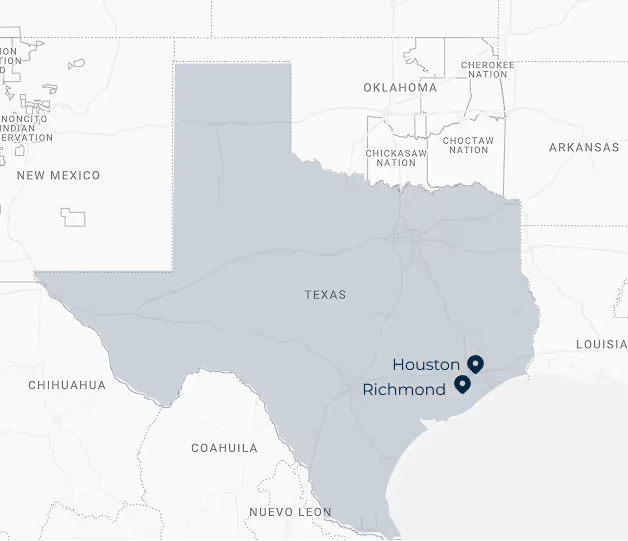
Our firm is based in the heart of Houston, primarily serving clients throughout Harris County. We also proudly extend our top-tier legal services to individuals and families in Fort Bend, Montgomery, Galveston, Brazoria, Waller, Wharton, and Austin counties.
- Harris County
- Austin County
- Brazoria County
- Brazos County
- Fort Bend County
- Galveston County
- Montgomery County
- Waller County
- Wharton County
Houston Office: 440 Louisiana St, Suite 977 Houston, TX 77002
Frequently Asked Questions
Generally, Texas prohibits modification within one year of your original order. However, exceptions exist when you can prove by affidavit that: (1) the child's current environment endangers their physical health or emotional development, (2) the primary conservator has voluntarily relinquished care for at least six months, or (3) the primary conservator consents to the modification.
A material and substantial change must significantly affect the child's circumstances or parenting abilities since the last order. Common examples include relocation, remarriage, changes in work schedule, development of substance abuse issues, family violence, or significant changes in the child's needs. Harris County courts evaluate each situation individually to determine if the threshold is met.
To enforce visitation rights in Houston, file a Motion for Enforcement in the court that issued your original order. The motion must specifically identify each violation with date, time, and the exact provision violated. After service on the other parent, a hearing will be scheduled where you must present evidence of willful violations. Remedies include make-up time, contempt findings, fines, and attorney's fees.
Contempt occurs when a parent willfully disobeys a custody order. To prove contempt, you must show the other parent: (1) knew what the order required, (2) had the ability to comply, (3) intentionally failed to comply, and (4) did so without justification. Penalties can include jail time up to six months per violation, fines up to $500 per violation, and other remedies.
Yes, Texas courts can impose jail sentences of up to six months per violation for contempt of court. However, first-time offenders often receive suspended sentences conditional on future compliance. Repeat violators face a higher likelihood of actual jail time, especially for serious or multiple violations.
In Harris County, agreed modifications typically take 60-90 days to complete, while contested modifications can take 6 to 12 months, depending on court scheduling, complexity, and whether a trial is necessary. Mandatory mediation and Harris County's co-parenting class requirements can affect this timeline.
While not legally required, having an attorney for enforcement proceedings is highly recommended. Enforcement cases involve strict procedural requirements and a high burden of proof. Defective pleadings or insufficient evidence can result in dismissed cases even when actual violations occurred. An experienced attorney ensures proper procedure is followed and maximizes your chances of successful enforcement.
Substantial evidence is essential for successful enforcement. Document each violation with dates, times, and details. Save all communications related to the violations. Collect witness statements when possible. Keep a detailed visitation journal. If police were involved, obtain report numbers. The more specific and comprehensive your evidence, the stronger your case will be.
Schedule Your
FreE Case Evaluation Session
Our office serves clients throughout Harris County and surrounding areas, including Montgomery, Fort Bend, Galveston, Brazoria, Waller, and Chambers counties. We offer flexible scheduling options to accommodate working parents' needs. Contact Longworth Law Firm today to schedule your case review session and take the first step toward resolving your child custody concerns.