
.avif)
.avif)
.avif)
.svg) 15+ Years
15+ Years
of Family Law Experience.svg) 2,000+ Cases
2,000+ Cases
on Family Law Resolved A+ Google
and BBB Rating.svg) Extensive Local
Extensive Local
Courts Expertise
Houston Child Visitation Representation Since 2011
Longworth Law Firm has handled child visitation cases for Houston parents since 2011. Founding attorney Daryl Longworth spent 28 years as a Houston Police Lieutenant before building a family law practice grounded in those same principles: read the facts, prepare thoroughly, and advocate without hesitation.
The firm holds an A+ BBB rating and has earned Houstonia Top Lawyers recognition. We are available around the clock because parenting-time disputes rarely wait for a convenient moment.

Possession and Access in Texas: What the Law Actually Says
Texas family courts do not use the word "visitation". The Texas Family Code, Chapter 153 governs possession and access within the broader conservatorship framework. Conservatorship covers decision-making authority, parental duties, and legal rights, not just a weekend schedule.
Every possession decision in Texas flows from one standard: the best interest of the child (Tex. Fam. Code § 153.002). Courts consider the child's age, health, emotional bonds with each parent, and the stability each home provides.
A Houston child visitation attorney at Longworth Law Firm builds possession cases around documented facts and your child's specific circumstances, not general arguments.
Possession Schedules Available Under Texas Law
Texas law offers three main frameworks for possession and access: the Standard Possession Order, the Extended Standard Possession Order, and custom schedules approved by the court. The right option depends on the parents' proximity, the child's age and needs, and the family's circumstances.
The Standard Possession Order
The Texas Family Code's Standard Possession Order applies as the default schedule for families living within 100 miles of each other. Under the SPO, the non-primary parent receives:
- First, third, and fifth weekends of each month (Friday evening through Sunday)
- Thursday evening periods during the school year
- Alternating major holidays, including Thanksgiving and Christmas
- Extended summer possession, typically 30 days
- Designated time on Mother's Day and Father's Day
- Electronic communication rights between the child and the non-possessing parent (Tex. Fam. Code § 153.015)
The Extended Standard Possession Order
The Extended SPO expands weekend possession from school dismissal on Friday through Monday morning when school resumes. Thursday visits become overnight stays. This schedule gives the non-primary parent close to 45% of the calendar year with the child while keeping school routines intact.
Custom Possession Arrangements
Standard schedules do not fit every family. As an experienced child visitation lawyer in Houston, Daryl Longworth regularly drafts customized possession plans for parents with rotating shift work, children with significant medical or educational needs, long-distance parenting situations, reintroduction schedules following extended absence, and cases where supervised visitation is required or contested. Precision in drafting prevents future disputes — vague possession order language is one of the most common triggers for enforcement litigation.
How Visitation Cases Move Through Harris County Courts
Child visitation cases in Harris County follow a defined procedural path. Each stage carries strategic weight, and what happens at one point directly affects what comes next.
Filing Requirements
When no divorce is pending, a parent seeking to establish possession rights files a Suit Affecting the Parent-Child Relationship (SAPCR) in Harris County. If a divorce is in progress, possession matters are resolved within that proceeding. Cases are filed with the Harris County District Clerk's Family Intake division.
Key filing requirements include:
- Verified jurisdiction (child has resided in Texas for at least six months, per Tex. Fam. Code § 152)
- Correct venue — typically Harris County if the child resides there
- Filing fees or an approved Statement of Inability to Afford Payment of Court Costs
- A properly completed original petition with all required information
- Service of process on the other parent
Temporary Orders
Shortly after filing, the court holds a temporary orders hearing to establish the possession schedule while the case is pending. These rulings create patterns courts are often reluctant to change later. Thorough preparation for this hearing directly shapes the trajectory of the full case.
Mediation
Harris County family courts require mediation before trial in most cases. Mediation gives parties more control over the outcome, reaches resolution faster, and produces orders more tailored to the family's actual situation. We prepare for every mediation with the same rigor as trial preparation.
Trial and Final Orders
When mediation does not produce an agreement, the case proceeds to a bench trial. The judge issues a final order covering conservatorship rights, primary residence designation, the possession and access schedule, and child support obligations. These orders govern until the child turns 18 or a court modifies them.
Modifying a Visitation Order When Circumstances Change
.webp)
Texas allows modification of a possession order when two conditions are met: a material and substantial change in circumstances has occurred since the original order, and the requested change serves the child's best interest (Tex. Fam. Code § 156.101).
What Qualifies as a Material Change
Courts have recognized the following as qualifying changes under Texas law:
- Relocation of either parent to a different city, county, or state
- Significant shifts in a parent's work schedule or availability
- Changes in the child's developmental, medical, or educational needs
- Evidence of family violence, substance abuse, or neglect
- A parent's repeated violations of the existing possession order
- The stated preference of a child aged 12 or older (considered, not controlling)
Geographic Restriction Modifications
Lifting geographic restrictions requires showing that the proposed move produces a concrete benefit for the child. The court also requires a workable alternative possession schedule for the non-primary parent. These cases rely on strong evidentiary records and precise legal arguments.
The modification process involves filing a Petition to Modify the Parent-Child Relationship, serving the other party, attending a temporary orders hearing if urgency warrants it, participating in mediation, and proceeding to trial if no agreement is reached.
Enforcing Court-Ordered Possession When the Other Parent Won't Comply

A court-issued possession order is a binding legal obligation. When the other parent repeatedly ignores it, Texas law provides concrete remedies — and Longworth Law Firm knows how to use them.
Common Violations
Denied possession periods, failure to surrender the child at the exchange location, interference with phone and video communication, and moves outside the permitted geographic area are among the most frequent enforcement issues Houston child visitation lawyers handle. Each represents a violation of a binding court order.
Legal Consequences for Violations
Texas Family Code Chapter 157 provides enforcement tools that carry real consequences:
- Contempt of court — fines or jail time for willful, documented violations
- Makeup possession time awarded to the parent who was denied access
- Modification of the underlying order when violations form a pattern
- Attorney's fees and court costs assessed against the non-compliant parent
- In severe cases, a reconsideration of primary conservatorship
Building a Record Before Filing
Enforcement cases are won on documentation. We counsel clients to maintain written communication logs, records of every exchange attempt, and co-parenting app message histories. A well-documented record of violations is far more persuasive than a narrative account.
Grandparent and Third-Party Possession Rights in Texas

Texas law permits grandparents and, in limited circumstances, other third parties to petition for court-ordered access. Under Tex. Fam. Code § 153.433, these petitions face a higher legal threshold than standard possession cases because Texas courts presume fit parents act in their child's best interest.
For a grandparent petition to succeed, the filing party generally must demonstrate:
- At least one parent's parental rights have not been terminated.
- The child's physical health or emotional development would be significantly impaired by denial of access.
- The petitioner can overcome the constitutional presumption that fit parents act in their child's best interest.
- Supporting facts sufficient to meet the "clear and convincing evidence" standard where applicable.
Step-parents and relatives who have served as primary caregivers may also qualify for possession or conservatorship under specific statutory conditions. Eligibility turns on the specific facts, not general family ties.
Supervised Visitation and Restricted Possession Orders

A court may order supervised visitation when safety concerns make unrestricted access inappropriate. Common triggers include allegations of family violence, substance abuse, untreated mental health conditions, a history of neglect, or a parent's extended absence requiring gradual reintroduction.
Supervision may be conducted by a neutral third party, a licensed visitation center, or a court-approved family member. Parents subject to supervised visitation who have made documented life changes can petition to modify toward unsupervised access.
Interstate Possession Disputes and the UCCJEA
When parents live in different states, possession matters are governed by the Uniform Child Custody Jurisdiction and Enforcement Act (UCCJEA), adopted by Texas in Family Code Chapter 152 and enacted by most other states. The UCCJEA determines which state holds jurisdiction based on home state status, significant connection, more appropriate forum, and vacuum jurisdiction.
Enforcing Texas Orders Out of State
A valid Texas possession order must be registered in the other state's courts before it can be enforced there. The UCCJEA obligates participating states to honor registered orders. We handle the registration process and enforcement proceedings wherever the child currently resides.
Relocation and Move-Away Cases
Relocation disputes are among the most contested possession matters in Texas family courts. Judges weigh the reason for the move, the impact on the other parent's relationship with the child, existing community ties, potential educational benefits, and the feasibility of an alternative possession schedule.

What Sets Longworth Law Firm Apart
in Houston Visitation Cases
Harris County Court Familiarity Built Over 15 Years
Longworth Law Firm has practiced in Harris County family courts for over 15 years. We know the local judges, procedural expectations, and the Harris County Domestic Relations Office — knowledge that directly affects how we position your case.
Evidence-First Case Strategy
Possession cases are decided on documented facts, not emotional arguments. We build evidentiary records around your parenting involvement, home stability, and any relevant conduct by the other party. Thorough preparation is what moves courts.
Assertive Advocacy with a Long-Term View
We pursue possession arrangements that protect your rights today and remain workable as your child grows. Short-term wins that damage the co-parenting relationship for years are not in your child's best interest.
.svg)
24/7 Availability for Houston Parents
Parenting emergencies do not follow a 9-to-5 schedule. We are available around the clock for Houston parents who need answers and cannot afford to wait until the next business day.
Counties and Communities
We Serve
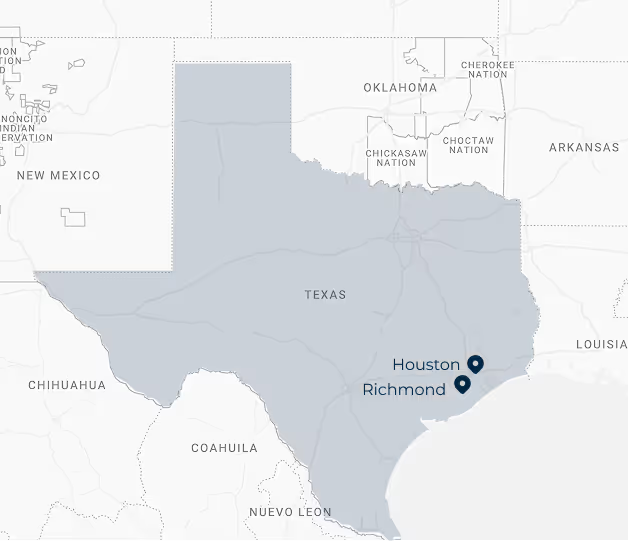
Longworth Law Firm serves parents throughout Harris County and the surrounding greater Houston region. If you are facing a child visitation matter anywhere in the area, our team is ready to help.
- Harris County
- Fort Bend County
- Montgomery County
- Galveston County
- Brazoria County
- Waller County
- Wharton County
Houston Office: 440 Louisiana St, Suite 977 Houston, TX 77002
Frequently Asked Questions
About Child Visitation in Texas
A child aged 12 or older may sign a written statement of preference regarding primary residence and possession. The court must consider it, but the judge retains full authority to set the schedule based on the best interest of the child standard.
The Standard SPO gives the non-primary parent alternating weekends, Thursday evenings, alternating holidays, and extended summer time. The Extended SPO expands weekends to begin Friday at school dismissal and end Monday morning, and converts Thursday visits to overnights. The difference amounts to roughly 10 percentage points of annual parenting time.
Grandparents have a limited but real statutory basis to petition for visitation. At least one parent's rights must remain intact, and the grandparent must show that denial of access would significantly impair the child's physical or emotional health. These petitions face a high evidentiary bar.
Violations are enforceable through contempt of court, resulting in fines, makeup possession time, and in willful cases, jail time. Repeated violations can also trigger modification proceedings. A child visitation attorney in Houston can help you choose the most effective enforcement remedy.
Relocation with a child subject to a geographic restriction requires the other parent's consent or a court order. The court weighs the reason for the move, its impact on the other parent's relationship with the child, and whether a workable alternative possession schedule can be designed.
A Suit Affecting the Parent-Child Relationship (SAPCR) is the legal proceeding used to establish or modify conservatorship, possession, and child support when no divorce is pending. If you were never married to the other parent or are seeking to change an existing order, a SAPCR is the correct filing.
Schedule Your Case Review with Longworth Law Firm
Our intake team gathers the key facts of your situation from the first call. We offer free case evaluations with no pressure and no obligation. Get direct answers before making any decision.