
.avif)
.avif)
.avif)
.svg) 15+ Years
15+ Years
of Family Law Experience.svg) 2,000+ Cases
2,000+ Cases
on Family Law Resolved A+ Google
and BBB Rating.svg) Extensive Local
Extensive Local
Courts Expertise
Experienced Houston Spousal Support Representation
At Longworth Law Firm, we bring 15 years of focused family law experience to spousal support cases throughout Houston and Harris County. Our founder, Daryl Longworth, combines advanced legal knowledge with 28 years of Houston Police experience to navigate the complexities of Texas spousal maintenance law. We understand that spousal support decisions significantly impact your financial future, and we're committed to securing fair outcomes through strategic advocacy and thorough preparation.
Our firm is recognized for transparent communication, client-focused service, and our commitment to using technology that makes the legal process more accessible. We're available 24/7 for questions that can't wait until business hours.

What Is Spousal Support in Texas?
Spousal support, legally known as "spousal maintenance" in Texas, is court-ordered financial assistance paid from one former spouse to the other for a specific period following divorce. Unlike many other states, Texas has restrictive spousal maintenance laws, with a legal presumption against awarding support unless specific statutory requirements are met.
The goal of spousal maintenance is to provide temporary financial assistance to help a former spouse gain employment, complete education, or develop job skills necessary to become self-supporting. Texas law emphasizes that spousal maintenance should be granted for the shortest time necessary for the receiving spouse to achieve financial independence.
Understanding the distinction between different types of post-divorce support is crucial for Houston residents navigating divorce:
Spousal Maintenance vs. Contractual Alimony in Texas

Texas recognizes two primary types of post-divorce support:
Spousal maintenance is court-ordered support governed by strict statutory requirements under the Texas Family Code. Courts can order spousal maintenance only when specific eligibility criteria are met, and payments are limited by statutory caps on the amount and duration.
Contractual alimony is support agreed upon by the spouses themselves and incorporated into their divorce decree. This type of arrangement offers greater flexibility in the amount, duration, and terms, but it's not court-ordered support in the traditional sense.
Temporary Spousal Support During Divorce Proceedings
During the divorce process, Texas courts may order temporary spousal support to help maintain the status quo while the case is pending. This temporary support helps ensure that neither spouse faces immediate financial hardship during the proceedings and can continue meeting basic living expenses.
Temporary support orders typically remain in effect until the divorce is finalized, at which point permanent arrangements (if any) take effect. These temporary orders can address immediate financial needs while allowing time to properly evaluate long-term support requirements.
Eligibility Requirements for Spousal Maintenance in Houston
Texas Family Code Section 8.051 establishes specific eligibility requirements that must be met before a court can order spousal maintenance. The requesting spouse must demonstrate both financial need and specific qualifying circumstances.
Basic Financial Eligibility Requirements
To qualify for spousal maintenance in Texas, the requesting spouse must prove they will lack sufficient property, including separate property, to provide for their minimum reasonable needs after the divorce. This evaluation considers:
- Income-producing assets and their capacity to generate support
- Liquid assets available for living expenses
- Real estate that could be sold or leveraged
- Retirement accounts and other investments
- Skills and education that could generate income
Courts assess the overall financial picture to determine whether the requesting spouse genuinely needs support to meet basic living expenses.
Specific Qualifying Circumstances Under Texas Law

Even when financial need exists, spousal maintenance can only be ordered if one of these specific circumstances applies:
Family violence conviction: The spouse from whom maintenance is sought was convicted of or received deferred adjudication for an offense involving family violence committed during the marriage or within two years of filing for divorce.
Disability preventing employment: The requesting spouse cannot earn sufficient income due to a physical or mental disability that is incapacitating.
Marriage duration and inability to be self-supporting: The marriage lasted 10 years or longer, and the requesting spouse is unable to earn sufficient income to meet minimum reasonable needs.
Custodial parent of disabled child: The requesting spouse has custody of a child from the marriage of any age who requires substantial care and personal supervision due to a physical or mental disability that prevents the spouse from earning sufficient income.
Factors Courts Consider in Houston Spousal Maintenance Cases
When determining whether to award spousal maintenance and in what amount, Harris County family courts evaluate numerous factors outlined in Texas Family Code Section 8.052:
- Each spouse's financial resources and property
- Education and employment skills of each spouse
- Duration of the marriage
- Age and employment history of the spouse seeking maintenance
- Physical and emotional condition of the requesting spouse
- Contribution by one spouse to the other's education, training, or increased earning power
- Property each spouse brought to the marriage
- Contribution of a spouse as a homemaker
- Marital misconduct, including adultery and cruel treatment
- Any history of family violence
Calculating Spousal Maintenance Amounts and Duration in Texas

Texas law places strict limits on both the amount and duration of spousal maintenance awards. These limitations reflect the state's preference for encouraging self-sufficiency rather than long-term dependence.
Maximum Payment Amounts Under Texas law
The amount of spousal maintenance cannot exceed the lesser of:
- $5,000 per month, or
- 20% of the paying spouse's average gross monthly income
"Gross monthly income" includes salary, wages, commissions, bonuses, interest, dividends, rental income, retirement benefits, and other income sources. However, the 20% calculation applies only to the first $9,200 of monthly gross income (as of 2025); the court has discretion over higher-income amounts.
Duration Limits Based on Marriage Length
Texas law establishes maximum durations for spousal maintenance based on the length of the marriage:
- Marriages of 10-20 years: Maintenance for up to 5 years.
- Marriages of 20-30 years: Maintenance for up to 7 years.
- Marriages of 30+ years: Maintenance for up to 10 years.
Exception for family violence: If the basis for maintenance is a family violence conviction, support may be ordered for up to 5 years regardless of marriage duration.
Exception for disability: When the requesting spouse has an incapacitating physical or mental disability, the duration may extend beyond these limits as warranted by the circumstances.
Guidelines for Determining Actual Awards
.webp)
While statutory maximums set the ceiling, actual awards depend on the specific circumstances of each case. Courts typically consider:
- The requesting spouse's reasonable monthly expenses
- Income disparity between the spouses
- Time needed to complete education or job training
- Age and health considerations affecting employability
- Childcare responsibilities that may limit work opportunities
At Longworth Law Firm, we use financial analysis as needed to present compelling evidence supporting appropriate maintenance amounts that meet our clients' needs while remaining within legal parameters.
Types of Spousal Support Cases We Handle
Seeking Spousal Maintenance in a Houston Divorce
When you believe you qualify for spousal maintenance, our firm conducts a thorough analysis of your financial circumstances and builds compelling evidence supporting your claim. We gather documentation regarding:
- Your current financial resources and monthly expenses
- Employment history and current income capacity
- Education, training, and job skills
- Health considerations affecting your ability to work
- Contributions you made to your spouse's career or education
- Your role as a homemaker or caregiver during the marriage
We present your case strategically, emphasizing factors that support both eligibility and the need for meaningful support amounts and duration.
Challenging Spousal Maintenance Claims

When your spouse seeks spousal maintenance, we thoroughly evaluate their claim and develop defenses when appropriate. This may involve:
- Challenging their claimed financial need
- Demonstrating their ability to be self-supporting
- Questioning whether they meet statutory eligibility requirements
- Presenting evidence of their income-earning capacity
- Examining the accuracy of their expense claims
Our goal is to ensure that any support obligation is fair, reasonable, and based on accurate information about both parties' circumstances.
Modifying Existing Spousal Maintenance Orders
Texas law allows modification of spousal maintenance when there has been a material and substantial change in circumstances. We handle modification cases involving:
- Significant changes in either party's income
- Completion of education or job training programs
- Remarriage or cohabitation of the supported spouse
- Changes in health or disability status
- Economic changes affecting the paying spouse's capacity
The Houston Spousal Support Process: What to Expect
Understanding the spousal maintenance process helps reduce uncertainty and enables better preparation for what lies ahead. While each case has unique aspects, spousal support proceedings in Harris County typically follow predictable stages.
Initial Evaluation and Case Assessment
Our process begins with a comprehensive analysis of your specific situation to determine whether spousal maintenance is appropriate. We examine:
- Your financial circumstances and demonstrated need for support
- Whether you meet the statutory requirements for maintenance
- The strength of your spouse's income and ability to pay
- Realistic expectations for support amounts and duration
- Strategic approaches for presenting your case
This initial assessment helps establish realistic goals and develop effective advocacy strategies tailored to your circumstances.
Temporary Support During Divorce Proceedings

In many cases, immediate financial relief is necessary while the divorce case proceeds. We can request temporary spousal support orders to:
- Ensure you can meet basic living expenses during the case.
- Maintain reasonable stability for you and your children.
- Preserve the status quo until permanent arrangements are determined.
- Address immediate financial emergencies or hardships.
Temporary orders hearings provide important insight into how the judge views your case and can influence final outcomes.
Discovery and Financial Analysis
A thorough investigation of both parties' financial circumstances is essential for spousal maintenance cases. The discovery process may include:
- Complete financial disclosure from both spouses
- Analysis of income, assets, and expenses
- Investigation of earning capacity and employment opportunities
- Review of financial contributions during the marriage
- Documentation of homemaker and childcare contributions
We ensure all relevant financial information is uncovered and properly presented to support your position.
Negotiation and Settlement Discussions

Many spousal support disputes can be resolved through negotiation rather than trial. Our approach to settlement discussions focuses on:
- Presenting compelling evidence supporting your position.
- Understanding the practical realities affecting both parties.
- Developing creative solutions that address everyone's needs.
- Ensuring any agreement complies with Texas legal requirements.
Attorney Longworth's background in law enforcement provides valuable insight during negotiations, particularly when dealing with complex personalities or challenging circumstances.
Trial Preparation and Court Presentation
When settlement isn't possible, we prepare thoroughly for the trial presentation of your spousal maintenance case. This includes:
- Organizing all supporting evidence and documentation.
- Preparing compelling testimony from you and potential witnesses.
- Developing clear legal arguments based on statutory requirements.
- Creating effective presentations for the court.
- Anticipating and preparing responses to opposing arguments.
Our extensive courtroom experience in Harris County family courts enables us to advocate effectively for your interests at trial.

Why Choose Longworth Law Firm
for Houston Spousal Support Cases
In-Depth Knowledge of Harris County Family Courts
With over 15 years of family law practice in Houston, we have extensive experience handling spousal maintenance cases in all Harris County family courts. Our familiarity with local procedures, judicial preferences, and court personnel enables us to navigate the system efficiently and effectively advocate for our clients.
Strategic Approach to Complex Financial Issues
Spousal support cases often involve complex financial analysis and strategic presentation of evidence. We combine legal knowledge with practical understanding of financial matters to build compelling cases that address both the legal requirements and practical realities of your situation.
Law Enforcement Background Advantage
Attorney Longworth's 28 years as a Houston Police Lieutenant provide unique insight into evaluating evidence, understanding human behavior, and maintaining composure under pressure. This background is particularly valuable during negotiations and court proceedings where credibility and strategic thinking are essential.
Transparent Communication and Client Education
We believe in keeping our clients informed throughout the legal process. You'll understand the strengths and challenges of your case, the applicable legal standards, and realistic expectations for outcomes. Our approach balances honest assessment with strong advocacy.
Proudly Serving the
Greater Houston Area
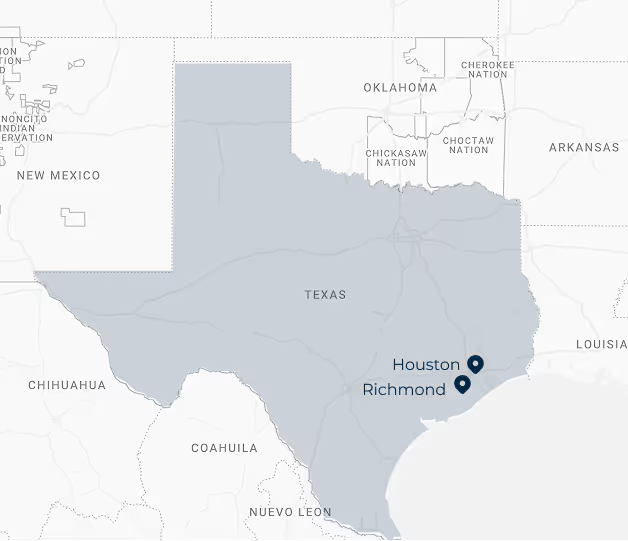
Our firm is based in Houston and primarily serves clients throughout Harris County. We also serve individuals and families in Fort Bend, Montgomery, Galveston, Brazoria, Waller, Wharton, and Austin counties. Our familiarity with family courts throughout the greater Houston area ensures effective representation regardless of where your case is filed.
- Harris County
- Austin County
- Brazoria County
- Brazos County
- Fort Bend County
- Galveston County
- Montgomery County
- Waller County
- Wharton County
Houston Office: 440 Louisiana St, Suite 977 Houston, TX 77002
Frequently Asked Questions About
Houston Spousal Support
Texas has some of the most restrictive spousal maintenance laws in the United States. Courts presume that spousal maintenance is not warranted, and the requesting spouse must prove both financial need and that they meet specific statutory requirements. Success requires thorough preparation, compelling evidence, and a strategic presentation of your case.
While challenging, spousal maintenance can be awarded when the legal requirements are met. Having experienced legal representation significantly improves your chances of obtaining appropriate support.
Yes. Spouses can agree to contractual alimony arrangements even when court-ordered maintenance is unavailable. These agreements offer greater flexibility in amounts, duration, and terms than court-ordered support. However, such agreements must be properly drafted and incorporated into the divorce decree to be enforceable.
For divorces finalized after December 31, 2018, spousal maintenance payments are not deductible by the paying spouse and are not considered taxable income to the receiving spouse. This change in federal tax law affects the economic impact of maintenance awards and should be considered when negotiating support arrangements.
The timeline for spousal maintenance cases varies depending on whether the issue is part of a larger divorce case or a standalone post-divorce modification. Cases involving significant disagreement about financial circumstances or complex asset evaluation may take longer to resolve.
When spousal maintenance is addressed in an uncontested divorce, the matter can be resolved within the standard 60- to 90-day divorce timeline. Contested cases typically take 6 to 12 months or longer, depending on case complexity and court schedules.
When spousal maintenance payments stop, immediate legal action is usually necessary to protect your rights. Texas provides several enforcement mechanisms, including contempt proceedings, wage-withholding orders, and asset seizures. The specific approach depends on your ex-spouse's circumstances and the reason for non-payment.
Acting quickly is important, as delays in enforcement can make it more difficult to collect unpaid support.
Yes, in some cases, spouses may agree to lump-sum payments instead of ongoing monthly support. This arrangement can provide certainty for both parties and eliminate the need for continued financial interaction. However, lump-sum arrangements must be carefully calculated to ensure they provide adequate support, taking into account tax implications and present value.
Schedule Your Spousal Support Consultation Today
Don't navigate Texas spousal maintenance law without experienced guidance. Whether you're seeking support, challenging a maintenance claim, or need assistance with enforcement or modification, Longworth Law Firm provides the knowledge and advocacy you need to protect your financial future.
Contact us today to schedule your confidential consultation. We serve clients throughout Harris County and the greater Houston area, including Fort Bend, Montgomery, Waller, Wharton, Galveston, Brazoria, and Austin counties.