
.avif)
.avif)
.avif)
.svg) 15+ Years
15+ Years
of Family Law Experience.svg) 2,000+ Cases
2,000+ Cases
on Family Law Resolved A+ Google
and BBB Rating.svg) Extensive Local
Extensive Local
Courts Expertise
Experienced Family Violence Lawyers in Harris County
Founded by Daryl Longworth, who served 28 years as a Houston Police Lieutenant before his 15-year legal career, our law firm brings a unique perspective to domestic violence cases. This distinctive background allows us to navigate both the legal system and law enforcement processes with advanced insider knowledge.
Our team provides 24/7 availability for emergency situations, combining assertive representation with empathetic support. Recognized by Houstonia as one of its Top Lawyers and maintaining an A+ BBB rating, we approach sensitive family safety matters with the urgency, discretion, and skill they demand.

Understanding Domestic Violence Under Texas Law
Texas uses specific legal terminology and frameworks that differ from those of other states. Understanding these distinctions is crucial to navigating your case effectively.
What Qualifies as Family Violence in Texas?
Under Texas Family Code §71.004, "family violence" is defined as an act by a family or household member against another that is intended to result in physical harm, bodily injury, assault, or sexual assault. It also includes threats that reasonably place a person in fear of imminent physical harm.
Importantly, Texas law doesn't require visible injuries or police reports to establish family violence. A judge can find that family violence occurred based solely on testimony and circumstantial evidence, which makes these cases particularly challenging.
Who Can Be Charged Under Texas Family Code §71.004
Texas law specifically defines which relationships fall under domestic violence statutes:
- Current or former spouses
- Parents of the same child, regardless of marriage
- Current or former dating partners
- Family members by blood, marriage, or adoption
- Current or former household members who reside together
- Foster parents and foster children
This broad definition means domestic violence charges can arise from conflicts with roommates, extended family members, and even former relationships that ended years ago
Domestic Violence vs. Dating Violence Definitions
Texas distinguishes between family violence and dating violence, though both can lead to protective orders and criminal charges:
Family Violence involves family members, household members, co-parents, or spouses (current or former). This includes parents, siblings, in-laws, and anyone related by blood or marriage.
Dating Violence specifically pertains to violence within a dating relationship, defined as a romantic or intimate relationship. Courts consider the length and nature of the relationship, frequency of interaction, and whether the relationship has terminated.
This distinction can affect court jurisdiction, available remedies, and the specific legal procedures that apply to your case.
Types of Domestic Violence Charges in Houston
Domestic violence cases in Texas can result in various criminal charges, ranging from misdemeanors to serious felonies with life-altering consequences.
Misdemeanor Assault Family Violence Charges
The most common domestic violence charge is Assault Family Violence (Texas Penal Code §22.01), typically charged as a Class A misdemeanor for first-time offenders. This charge carries penalties of:
- Up to one year in county jail
- Fines up to $4,000
- Mandatory batterer's intervention programs
- Protective orders limiting contact with the alleged victim
- Loss of firearm rights under federal law
Even as a misdemeanor, this charge creates a permanent criminal record that can affect employment, housing, and custody rights for years to come.
Felony Domestic Violence Offenses
Domestic violence charges escalate to felonies under certain circumstances:
- Second offenses - A second domestic violence charge becomes a third-degree felony, even if the first resulted only in deferred adjudication.
- Choking/strangulation - Allegations involving impeding breathing or circulation are automatically charged as third-degree felonies.
- Serious bodily injury - Cases involving substantial injuries may be charged as second-degree or first-degree felonies.
- Use of a deadly weapon - Using or exhibiting a weapon during family violence elevates the charge to aggravated assault.
Felony charges carry significantly harsher penalties, including 2 to 10 years in prison for third-degree felonies and up to 20 years for second-degree felonies.
Aggravated Assault in Family Violence Cases
Aggravated Assault Family Violence involves either causing serious bodily injury or using/exhibiting a deadly weapon during the assault. This second-degree felony carries:
- 2 to 20 years in prison
- Fines up to $10,000
- Long-term protective orders
- Permanent loss of firearm rights
- Lifelong consequences for employment and housing
The definition of a "deadly weapon" is surprisingly broad—kitchen knives, household objects, and even vehicles can be classified as deadly weapons depending on how they were allegedly used.
Continuous Violence Against the Family
A unique Texas charge is Continuous Violence Against the Family (Texas Penal Code §25.11), which applies when two or more family violence incidents occur within a 12-month period, even if neither incident resulted in arrest or conviction.
This third-degree felony carries a sentence of 2 to 10 years in prison and a fine of up to $10,000. The prosecution only needs to prove two acts of violence, regardless of whether they were reported at the time.
Protective Orders in Houston: Types and Process
Protective orders are court orders designed to prevent future violence by restricting contact between parties. Understanding the different types and how they're obtained is crucial, whether you're seeking protection or defending against an application.
Emergency Protective Orders (EPO) from Magistrates
Also called a Magistrate's Order for Emergency Protection (MOEP), this order is:
- Issued by a magistrate after a domestic violence arrest
- Available even without the victim's request in serious cases
- Valid for 31-91 days (61-91 days if a weapon was involved)
- Put in place before the arrested person is released on bail
- More limited in scope than other protective orders
EPOs typically prohibit communication, going near the residence or workplace of the protected person, and possessing firearms. Violation is a separate criminal offense.
Temporary Ex Parte Protective Orders
These short-term orders are:
- Granted without a full hearing (the accused isn't present)
- Based solely on the applicant's sworn statement
- Valid for up to 20 days (can be extended for additional 20-day periods)
- Intended to provide immediate protection until a full hearing
- Typically includes "kick-out" provisions forcing the accused to leave a shared residence
To obtain a temporary order, the applicant must show a clear and present danger of family violence. While these orders have serious immediate consequences, they do provide notice of the upcoming hearing where you can present your side.
Final Protective Orders After Hearing
A final protective order is issued after a full court hearing, during which both parties may present evidence. These orders:
- Last up to two years (or longer in serious cases)
- Require proof that family violence occurred and is likely to occur again
- Provide comprehensive prohibitions on contact and communication
- May include child custody, support, and property provisions
- Can include mandatory counseling or treatment
- Result in automatic firearm prohibitions
- Create a permanent record accessible in background checks
The hearing for a final protective order typically occurs within two weeks of the issuance of the temporary order, making prompt legal representation essential.
How to Obtain a Protective Order in Harris County
In Harris County, protective orders can be obtained through several channels:
- Harris County District Attorney's Office Family Criminal Law Division - Provides free assistance for victims, located at 1310 Prairie Street
- Aid to Victims of Domestic Abuse (AVDA) - Offers free legal help for protective orders
- Private attorney representation - Provides personalized guidance throughout the process
The application process involves:
- Completing detailed forms describing the violence or threats
- Providing specifics about dates, locations, and the nature of abuse
- Submitting the application to the appropriate court
- Appearing before a judge for the ex parte hearing
- Arranging for the other party to be served with notice
- Preparing for and attending the final hearing
Navigating this process without legal representation can be challenging, particularly when preparing evidence and testimony for the final hearing.
Defending Against Protective Order Applications
Being served with a protective order application can be shocking and disruptive. Understanding your rights and how to respond effectively is crucial.
Your Rights When Served with a Protective Order
When served with notice of a protective order application, you have important rights:
- The right to receive proper legal notice with adequate time to prepare
- The right to representation by an attorney
- The right to present evidence and witnesses at the hearing
- The right to cross-examine the applicant and their witnesses
- The right to testify on your own behalf
- The right to appeal an adverse decision
However, these rights must be exercised correctly and strategically, which is why immediate legal representation is essential.
Preparing for Your Harris County Hearing
Effective preparation includes:
- Gathering evidence that contradicts the allegations
- Collecting communications (texts, emails, social media) that show the relationship context
- Identifying potential witnesses who can provide relevant testimony
- Developing a timeline of events around the alleged incidents
- Preparing to testify effectively if appropriate
- Understanding the specific allegations to address each claim
- Creating a strategy for cross-examination
The limited time before the hearing makes quick action crucial. Evidence gathered early often proves decisive.
What Happens at a Protective Order Hearing
Protective order hearings in Harris County typically follow this process:
- The applicant (or their attorney) presents their case first, including testimony and evidence
- You or your attorney can cross-examine the applicant and their witnesses
- You present your defense, including your testimony and evidence
- The applicant's side can cross-examine you and your witnesses
- Both sides make closing arguments
- The judge makes an immediate decision
These hearings move quickly — often lasting only 30 to 60 minutes — making thorough preparation essential.
Modifying or Dismissing Protective Orders
If a protective order is issued against you, options exist to address it later:
- Modification - If circumstances change, you can request the court modify terms that are unnecessarily restrictive
- Mutual orders - In some cases, courts will consider mutual protective orders if both parties engaged in violence
- Early termination - After at least one year, you can request termination if you can prove there's no continuing need for protection
- Appeal - You have a limited time to appeal the decision to a higher court
- Agreement - Sometimes the protected person will agree to dismiss or modify the order
Each option requires specific legal procedures and substantial evidence of changed circumstances or original error.
Protective Order Violations and Enforcement
Understanding the serious consequences of violating protective orders and how allegations of violations are handled is crucial, whether you're protected by an order or subject to one.
What Constitutes a Protective Order Violation
Protective orders typically prohibit:
- Direct communication via any medium (phone, text, email, social media)
- Communication through third parties (except attorneys in some cases)
- Being within a specified distance of the protected person (typically 200-500 feet)
- Going near the protected person's residence or workplace
- Possessing firearms or ammunition
- Harassing or threatening behavior
- Certain actions regarding children or property
Any violation, even seemingly minor ones like a text message or brief phone call, can result in criminal charges—regardless of whether the protected person initiated or consented to the contact.
Criminal Consequences of Violating Orders
In Texas, violating a protective order is typically charged as a Class A misdemeanor, punishable by:
- Up to one year in county jail
- Fines up to $4,000
- Mandatory arrest when reported
- No opportunity for a bond until seeing a magistrate
Multiple violations or violations involving violence can be charged as third-degree felonies with penalties of 2 to 10 years in prison. Additionally, violation of federal firearm prohibitions carries separate federal felony charges with up to 10 years in federal prison.
Defending Against Violation Charges
Defenses to protective order violation charges include:
- Lack of knowledge of the order (if you weren't properly served)
- Lack of intent (accidental or inadvertent contact)
- Location defense (you weren't actually within the prohibited distance)
- Invitation by the protected person (though this is not an absolute defense)
- Mistaken identity or false allegations
- Constitutional challenges to overly broad order provisions
These defenses require careful evidence gathering and legal analysis. Many people mistakenly believe that if the protected person initiates contact, they cannot be charged with a violation. This is dangerously incorrect.

Why Choose Our Houston
Domestic Violence Attorneys
Former Prosecutor Experience in Harris County
Attorney Daryl Longworth's 28 years of service as a Houston Police Lieutenant provide invaluable insight into how domestic violence cases are investigated and prosecuted. This background gives our clients a significant advantage, whether defending against accusations or seeking protection.
Proven Results in Domestic Violence Cases
Each case is unique, and while past results don't guarantee future outcomes, our experience provides the foundation for effective representation in your case.
.svg)
Efficient & Cost-Effective Solutions
Our goal is to resolve your case as effectively as possible, minimizing unnecessary costs and delays. We focus on strategic, goal-oriented actions to protect you.
Assertive Representation, Compassionate Support
Our approach balances efficiency with understanding, providing the legal guidance you need while acknowledging the human aspects of your complex and emotionally challenging situation.
Proudly Serving
the Greater Houston Area
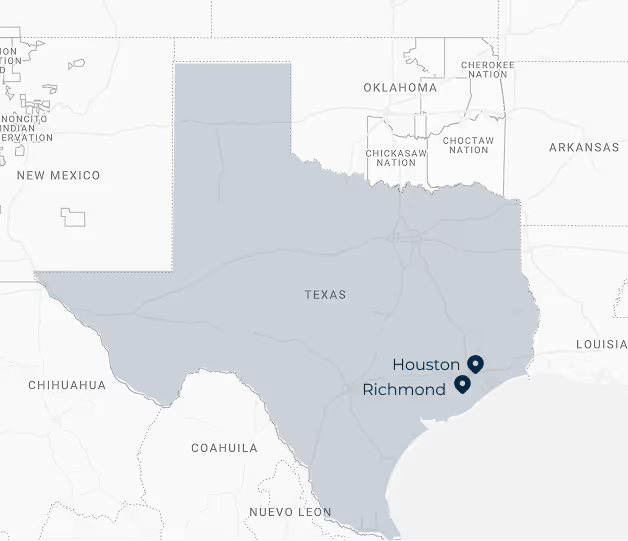
Our firm is based in the heart of Houston and primarily serves clients throughout Harris County. We also proudly extend our top-tier legal services to individuals and families in Fort Bend, Montgomery, Galveston, Brazoria, Waller, Wharton, and Austin counties.
- Harris County
- Austin County
- Brazoria County
- Brazos County
- Fort Bend County
- Galveston County
- Montgomery County
- Waller County
- Wharton County
Houston Office: 440 Louisiana St, Suite 977 Houston, TX 77002
Frequently Asked Questions About Houston
Domestic Violence Cases
In Texas, protective orders typically last up to two years. However, the court has discretion to issue orders for shorter periods (as little as one year) or more extended periods (up to a lifetime), depending on the circumstances. Longer orders are common when there's a history of severe violence, violations of previous orders, or use of deadly weapons. Emergency protective orders (EPOs) last between 31 to 91 days, while temporary ex parte orders last up to 20 days until the full hearing can take place.
In Texas, protective orders specifically address family or domestic violence and have criminal enforcement mechanisms. Violating a protective order is a criminal offense with potential jail time. Restraining orders are civil court directives typically issued during divorce or custody cases and don't carry the same criminal penalties for violations. Protective orders also automatically trigger federal firearm prohibitions and appear in background checks, while standard restraining orders generally do not.
Violating a protective order in Harris County results in immediate arrest if reported to law enforcement. The violation is typically charged as a Class A misdemeanor punishable by up to one year in jail and a $4,000 fine. Repeat violations or violations involving violence can be charged as third-degree felonies with 2 to 10 years in prison. Even if the protected person initiated contact or consented to it, the subject of the order can still be arrested and charged with violation.
In Houston, you can file for a protective order through the Harris County District Attorney's Office Family Criminal Law Division (1310 Prairie Street), through Aid to Victims of Domestic Abuse (AVDA), or with a private attorney. The process involves completing an application detailing the abuse, appearing before a judge for a temporary order, ensuring the respondent is served with notice, and attending a final hearing (usually within 14 days). The process is free through the DA's office, though private representation involves legal fees.
Yes, protective orders can be modified or terminated in Texas under certain circumstances. After at least one year, the respondent can file a motion to vacate (remove) the order by proving there's no continuing need for protection. The protected person can also file to modify or terminate the order at any time. The court has discretion to deny these requests if it determines there's still a risk of violence. A motion to vacate requires a formal hearing where evidence of changed circumstances must be presented.
Effective evidence for a protective order hearing includes: photographs of injuries, medical records, police reports, threatening text messages or emails, voicemails, witness statements, social media posts showing threats or admissions, 911 call recordings, and detailed personal documentation of incidents with dates and descriptions. The court applies a "preponderance of the evidence" standard, meaning you need to show it's more likely than not that family violence occurred and will likely occur again in the future.
Yes, protective orders appear on background checks in Texas. Final protective orders are entered into the Texas Crime Information Center and National Crime Information Center databases, making them visible to employers, landlords, and licensing agencies conducting background checks. Even temporary orders may appear in some county record searches. Unlike some criminal matters, protective orders cannot be expunged or sealed, creating permanent records that can affect employment, housing, and professional licensing.
A protective order can significantly impact child access, but doesn't automatically terminate all contact. The court may allow supervised visitation, exchanges through third parties, or specific limited contact regarding children. If your children are protected parties under the order, all contact may be prohibited until the order expires or is modified. Even if children aren't named in the order, standard protective order language often creates practical barriers to exercising regular visitation. An attorney can help request specific provisions to maintain appropriate parent-child relationships.
Legal representation for protective order cases in Houston typically costs between $1,500 and $5,000, depending on case complexity and whether it involves related criminal charges or family law matters. Some attorneys charge flat fees for protective order hearings ($1,500 to $3,000), while others charge by the hour ($250 to $450 per hour). Free legal assistance is available through the Harris County District Attorney's Office for protective order applicants, but respondents (those defending against orders) generally must hire private attorneys or seek assistance through legal aid if they qualify financially.
Yes, you can obtain a protective order in Houston without a police report. While police reports provide helpful documentation, Texas law does not require official reports to qualify for protection. The court considers testimony and other evidence of family violence, including texts, emails, photographs, medical records, and witness statements. Many successful protective orders are granted based primarily on the applicant's sworn testimony about violence or threats when supported by other circumstantial evidence.
Call Our HoustoN Domestic Violence Legal Team
Don't let crucial deadlines pass or make statements that could harm your case. Contact Longworth Law Firm today to schedule your confidential case assessment and take the first step toward resolving your domestic violence or protective order matter.