
.avif)
Houston Prenuptial and Postnuptial
Agreement Lawyer
Before and After Marriage
.avif)
.avif)
.svg) 15+ Years
15+ Years
of Family Law Experience.svg) 2,000+ Cases
2,000+ Cases
on Family Law Resolved A+ Google
and BBB Rating.svg) Extensive Local
Extensive Local
Courts Expertise
Experienced Prenuptial & Postnuptial Agreement Lawyers in Harris County
Daryl Longworth spent 28 years as a Houston Police Lieutenant before building a 15-year legal career in Texas family law. That background shapes how our Houston prenuptial agreement lawyers and postnuptial agreement attorneys approach every case: anticipating disputes, documenting everything, and drafting agreements that hold up in Harris County courts.
Available 24/7, Houstonia Top Lawyers-recognized, and A+ rated by the Better Business Bureau, our firm handles each matter with precision, discretion, and care.

Understanding Prenuptial & Postnuptial Agreements Under Texas Law
Texas has its own legal framework governing marital agreements, and it differs from many other states in meaningful ways. Knowing those distinctions is critical to ensuring your agreement is valid, enforceable, and actually does what you intend it to do.
What Is a Prenuptial Agreement Under Texas Law?
A prenuptial agreement, also called a "premarital agreement", is a written contract two people enter into before marriage. It establishes how assets, debts, and property rights will be handled during the marriage and in the event of divorce or death. In Texas, these agreements are governed by Texas Family Code Chapter 4, which adopted the Uniform Premarital Agreement Act.
Prenuptial agreements can address property classification, spousal support, business ownership interests, inheritance rights, and how specific assets like real estate or retirement accounts will be treated. One important nuance sets Texas apart from many other states: courts focus primarily on whether the agreement was signed voluntarily and whether the required legal formalities were met, not whether the agreement is "fair" at the time of enforcement.
What Is a Postnuptial Agreement Under Texas Law?
A postnuptial agreement is a written contract entered into by spouses after marriage. It governs property rights, debt allocation, and financial arrangements between spouses. Because the parties are already in a legal marital relationship when they sign, Texas courts apply heightened scrutiny to voluntariness and fairness.
Common reasons Houston clients seek postnuptial agreements include converting community property to separate property, protecting a business acquired during the marriage, or restructuring financial arrangements after a major life change such as an inheritance or significant debt. Neither a prenuptial nor a postnuptial agreement can address child custody or child support, as courts retain exclusive jurisdiction over those matters.
Types of Prenuptial & Postnuptial Agreement Provisions in Houston

Prenuptial and postnuptial agreements can address a wide range of financial and property matters. The specific provisions included depend on each couple's unique circumstances, assets, and goals. Working with an experienced Houston family law attorney ensures the agreement is legally sound and tailored to Texas law.
Property and Asset Division Provisions
Property and asset division is the most common category of provisions in both prenuptial and postnuptial agreements. Without a clear agreement in place, Texas community property laws will govern division, and that outcome may not reflect what either party intended.
Property provisions typically address:
- Designation of separate vs. community property: Specifying which assets each spouse owns individually and which are shared.
- Treatment of pre-marital assets and debts: Ensuring what you owned before marriage remains yours.
- Classification of property acquired during marriage: Defining whether new assets become community or separate property.
- Rights to specific real estate, investments, or retirement accounts: Protecting high-value individual assets from division.
- Division of property upon divorce: Establishing a clear framework that replaces the default Texas community property rules.
Spousal Support and Alimony Provisions
.webp)
Prenuptial and postnuptial agreements can establish, limit, or waive spousal support, which Texas law calls "spousal maintenance". Common provisions include:
- Waiver of spousal support: One or both spouses agree to forgo any claim to maintenance in the event of divorce.
- Fixed support amount or duration: The agreement sets a specific dollar amount or time period for any support obligation.
- Triggering event provisions: Support terms that activate or adjust based on specific circumstances.
One firm limit applies: Courts will not enforce a support waiver that would leave a spouse eligible for public assistance.
Business Ownership and Professional Practice Provisions
Protecting a business, professional practice, or partnership interest is one of the primary reasons Houston clients seek prenuptial or postnuptial agreements. Without these provisions, a spouse may have a valid community property claim to business value accumulated during the marriage. Business provisions typically cover classification of the business as separate property, protection of business growth, limits on a spouse's claim to business income, and buyout terms upon divorce.
Inheritance, Estate, and Death-Related Provisions
Prenuptial and postnuptial agreements can address what happens to assets upon a spouse's death, working alongside a will or estate plan. This category is particularly important for blended families, clients with children from prior relationships, and clients with significant inherited wealth. These provisions must be carefully coordinated with a broader estate plan to avoid conflicts that create costly legal disputes.
#cta_start
Protect What You've Built
Our attorneys draft enforceable agreements tailored to your financial goals and Texas law.
#cta_end
Prenuptial & Postnuptial Agreements in Houston: Requirements and Process
Prenuptial and postnuptial agreements must meet specific legal requirements to be enforceable in Texas. Whether you are creating an agreement from scratch or reviewing one that has been presented to you, the drafting process and those requirements both matter.
Legal Requirements for a Valid Prenuptial Agreement in Texas
Texas law sets clear conditions for a prenuptial agreement to be enforceable:
- Must be in writing and signed by both parties
- Must be signed voluntarily, without duress, fraud, or undue influence
- Must be executed before the marriage ceremony takes place
- Does not require consideration beyond the marriage itself
- Financial disclosure is not strictly required by statute, but inadequate disclosure can be used to challenge enforceability later
Harris County courts will scrutinize voluntariness and disclosure carefully, especially when one party later claims they did not fully understand what they signed.
Legal Requirements for a Valid Postnuptial Agreement in Texas
The requirements for a valid postnuptial agreement are similar, but with important distinctions that reflect the heightened scrutiny courts apply:
- Must be in writing and signed by both spouses
- Must be entered into voluntarily, a standard courts examine more carefully than with prenuptial agreements
- Should include full and fair financial disclosure from both parties
- Must have independent consideration beyond the existing marital obligation in some circumstances
- Cannot be unconscionable at the time of signing
Because postnuptial agreements face heightened scrutiny, having independent legal counsel for each spouse is strongly advisable and in some cases essential to enforceability.
What Can and Cannot Be Included in a Marital Agreement
Texas law places specific limits on what marital agreements can and cannot address.
Knowing these boundaries before drafting prevents provisions that courts will refuse to enforce regardless of what both parties agreed to. A Houston prenuptial agreement attorney reviews every term against current Texas Family Code requirements before the agreement is finalized.
How to Draft a Prenuptial or Postnuptial Agreement in Harris County
The proper drafting process follows these steps:
- Initial consultation to discuss goals, assets, debts, and concerns with your attorney
- Full financial disclosure from both parties, including asset lists, debt schedules, and income documentation
- Attorney drafts the agreement based on the terms both parties have agreed to address
- Both parties review the draft, ideally with independent legal counsel for each spouse
- Revisions and negotiation of specific terms until both parties are satisfied
- Signing before a notary, with prenuptial agreements executed well in advance of the wedding date
Attempting to draft or sign an agreement without legal representation significantly increases the risk of unenforceability.
Grounds for Challenging a Prenuptial or Postnuptial Agreement in Texas

Texas courts recognize several legal grounds on which a marital agreement can be challenged. Each requires substantial evidence and a clear legal strategy.
- Involuntariness: The agreement was signed under duress, coercion, or undue influence from the other party.
- Fraud or misrepresentation: One party concealed or misrepresented assets or debts at the time of signing.
- Unconscionability: The agreement was grossly unfair at signing, and the challenging party was not given adequate financial disclosure.
- Lack of independent counsel: Particularly relevant for postnuptial agreements where courts expect each party to have had separate representation.
- Procedural defects: The agreement was not in writing, not properly signed, or not notarized as required.
- Timing issues: The agreement was signed too close to the wedding date, which courts may treat as evidence of duress.
- Violations of Texas law or public policy: Specific provisions that courts will refuse to enforce regardless of what the parties agreed to.
Successfully challenging a marital agreement requires more than simply claiming unfairness after the fact. Courts look for concrete evidence tied to the circumstances at the time of signing. If you were pressured to sign quickly, denied access to the other party's financial records, or not given a realistic opportunity to consult an attorney, those facts can form the foundation of a viable challenge. Our attorneys work with clients across Harris County to evaluate whether a challenge has merit, gather the necessary documentation, and present a focused argument to the court. Early action is critical because delay can weaken a challenge and limit available remedies. Our Houston divorce attorneys regularly advise clients who have been handed agreements with little time to review them.
Enforcing Your Marital Agreement in Harris County Court

When a valid prenuptial or postnuptial agreement is contested, enforcing it requires a focused, evidence-based strategy. Our approach typically includes:
- Presenting the original signed agreement and any amendments as primary evidence of the parties' intent.
- Demonstrating that full financial disclosure was provided at the time of signing.
- Showing that both parties had adequate time and opportunity to seek independent legal counsel.
- Providing documented evidence that the agreement was signed voluntarily, including communications and timeline records.
- Challenging the credibility of claims of duress or misrepresentation with specific factual evidence.
- Requesting attorney's fees from the challenging party if the challenge is found to be without legal merit.
Many challenges to marital agreements fail when the original drafting process was properly documented. Working with an experienced attorney from the start makes a measurable difference in how these disputes resolve. Courts in Harris County expect clear records of disclosure, independent review, and voluntary execution. When those records exist, enforcement becomes significantly more straightforward.

Why Choose Our Prenuptial & Postnuptial
Agreement Attorneys
Our Houston prenuptial agreement attorneys and postnuptial agreement lawyers bring a combination of legal precision, real-world experience, and personal dedication that sets Longworth Law Firm apart in Harris County.
Law Enforcement-Trained Legal Precision
Daryl Longworth's 28 years as a Houston Police Lieutenant built the habit of anticipating disputes before they occur and documenting every detail that matters. That same disciplined approach applies directly to drafting prenuptial and postnuptial agreements built to withstand court scrutiny.
24/7 Availability When It Matters Most
Marital agreement timelines don't follow business hours. Our firm is reachable around the clock so that questions, urgent revisions, or last-minute concerns are handled without delay — not rescheduled for next week.
Recognized Track Record in Harris County
Houstonia Top Lawyers recognition and an A+ rating from the Better Business Bureau reflect consistent client outcomes and professional standards. Our familiarity with local courts and judges informs how we draft, negotiate, and enforce agreements.
.svg)
Comprehensive Coverage of Financial Complexity
From business ownership and professional practice protection to blended-family inheritance planning and retirement account classification, our attorneys handle agreements involving real financial complexity — not just straightforward asset lists.
Serving Clients Across
Houston and Surrounding Areas
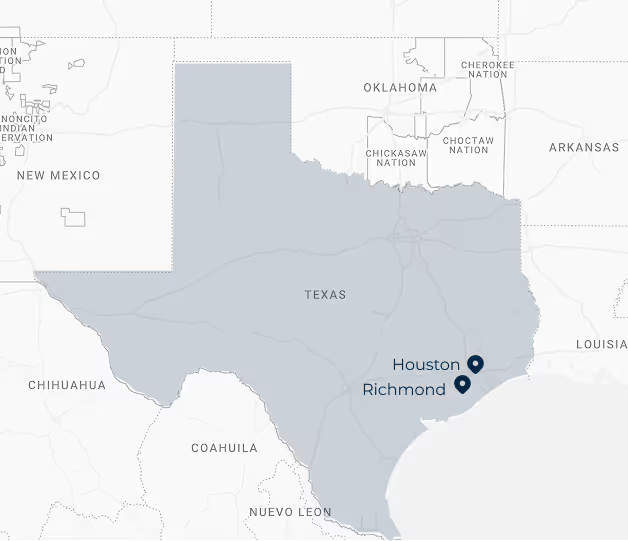
Our Houston prenuptial agreement lawyers and postnuptial agreement attorneys represent clients throughout the greater Houston metropolitan area. Whether you are located in the city or in one of the surrounding counties, our firm provides the same focused legal attention:
- Harris County
- Fort Bend County
- Montgomery County
- Galveston County
- Brazoria County
- Waller County
- Wharton County
Houston Office: 440 Louisiana St, Suite 977 Houston, TX 77002
Frequently Asked Questions: Houston Prenuptial & Postnuptial Agreements
A prenuptial agreement is signed before marriage. A postnuptial agreement is signed after. Both govern property rights and financial matters, but postnuptial agreements face heightened court scrutiny because the parties are already in a legal marital relationship when they sign.
Texas prenuptial agreements can address property classification, asset division, spousal support, and inheritance rights. They cannot include child custody arrangements, child support obligations, or any provision that violates Texas law or public policy.
Yes, prenuptial agreements are enforceable in Houston and throughout Harris County when they meet the requirements of Texas Family Code Chapter 4. The agreement must be in writing, signed voluntarily by both parties, and executed before the marriage ceremony. Inadequate financial disclosure or evidence of duress can affect enforceability.
A prenuptial agreement makes sense any time one or both partners bring significant assets, business interests, debts, or children from a prior relationship into the marriage. A postnuptial agreement is worth considering after a major financial change, such as starting a business, receiving a large inheritance, or taking on significant debt. Planning ahead is practical, not pessimistic.
Texas law requires a prenuptial agreement to be in writing and signed by both parties, but notarization is not strictly required for enforceability under Texas Family Code Chapter 4. That said, notarization provides an additional layer of evidence that both parties signed voluntarily and understood what they were signing, which becomes relevant if the agreement is later challenged in court. Most experienced prenuptial agreement attorneys in Houston recommend notarizing the document as a standard precaution.
Yes. A prenuptial agreement can be amended or revoked after marriage through a written agreement signed by both spouses. That post-marriage modification is itself subject to the same legal standards that apply to postnuptial agreements, including the heightened scrutiny Texas courts apply to agreements signed after the marital relationship has been established. Both parties should have independent legal counsel review any modification before signing.
Start Protecting Your Financial Future Today
Whether you are planning ahead or responding to an agreement you have been handed, our Houston prenuptial agreement attorneys and postnuptial agreement lawyers are ready to help. Call Longworth Law Firm to schedule your free consultation.